Cancer Diagnosis Without Surgery — Biopsy Every Day at KCC
Before any cancer treatment can begin, the cancer must be confirmed by biopsy. At KCC, image-guided needle biopsy is available every day — guided by CT or ultrasound to reach exactly the right spot, wherever in the body the suspected tumour is. Results are reported rapidly. No surgery required. No general anaesthesia in most cases. This is what makes KCC one of the fastest places in Nepal to go from suspected cancer to confirmed diagnosis and treatment.
The Doctor Behind the Diagnosis — and Behind Treatments You Didn't Know Didn't Need Surgery
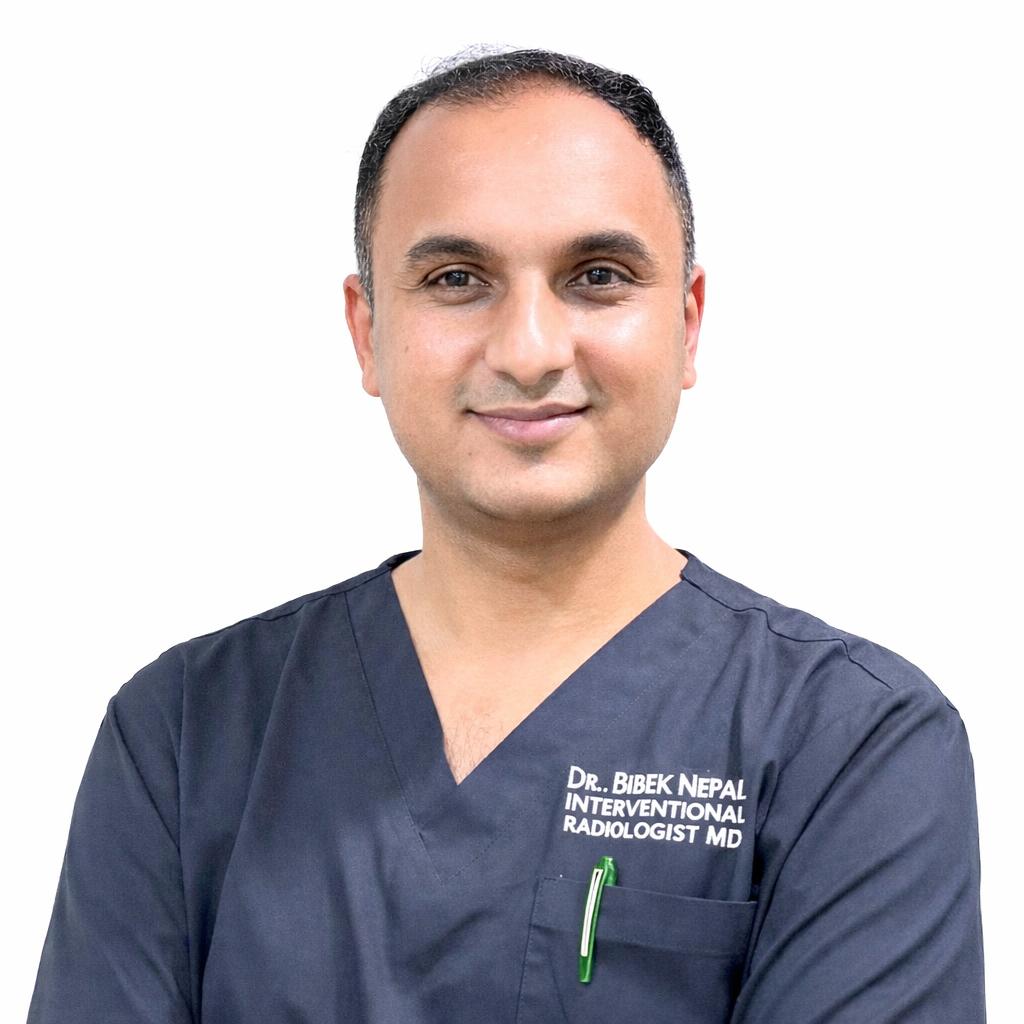
Dr. Bibek Nepal completed his MD in Radiodiagnosis at Tribhuvan University Teaching Hospital (TUTH) and then trained as an Interventional Radiologist at Max Superspeciality Hospital, Saket, New Delhi — one of India's leading centres for interventional radiology.
"Interventional radiology sits at the intersection of imaging and treatment. Every needle we place is guided. Every decision is real-time. The patient gets a diagnosis — or a treatment — without an operation. That matters enormously when they are already facing cancer."
At KCC, Dr. Nepal runs the interventional radiology programme that underpins the entire oncology workflow. When a tumour is seen on a scan, it is Dr. Nepal who confirms it with a biopsy. When a patient with liver cancer cannot have surgery, it is Dr. Nepal who ablates the tumour with heat through a needle. When a cancer blocks the bile duct and the patient turns yellow, it is Dr. Nepal who drains it without open surgery. These are not secondary services — they are the procedures that make the rest of cancer care possible.
Need a Biopsy in Kathmandu? KCC Does It Every Day — With Rapid Results
A biopsy is the only way to confirm cancer — and the faster it happens, the faster treatment can start. KCC is one of the very few centres in Nepal offering image-guided biopsy every working day, performed by a fellowship-trained interventional radiologist, with a dedicated pathology team for rapid reporting.
Rapid Biopsy Reporting — One of the Fastest in Nepal
FNAC (cytology) results may be available same day. Core biopsy histopathology typically within 2–3 working days. Urgent cases are expedited. The KCC pathology team works directly with the IR team — no delays from fragmented referral chains. This speed matters when a patient is waiting to start treatment.
Liver Tumour Destroyed With a Needle — No Surgery, Home the Same Day
Not every liver tumour needs an operation. For many patients with liver cancer (HCC) or cancer that has spread to the liver, tumour ablation — using heat delivered through a needle — can destroy the tumour completely. The needle is guided precisely to the tumour under CT or ultrasound. No incision. No stitches. Most patients return home the same day or the following morning.
Liver Cancer (HCC)
Radiofrequency Ablation (RFA)
A thin needle electrode is placed inside the tumour and radiofrequency energy creates heat that destroys cancer cells. Best for tumours up to 3–5 cm with up to 3 lesions.
Liver Cancer & Metastases
Microwave Ablation (MWA)
Faster and more powerful than RFA — effective for larger tumours and in locations near blood vessels where RFA is less reliable. Fewer sessions required.
HCC — Larger or Multifocal
TACE — Transarterial Chemoembolisation
Chemotherapy is delivered directly into the artery feeding the tumour, combined with particles that block the blood supply — starving and poisoning the cancer simultaneously.
Kidney Tumour
Renal Ablation (RFA/MWA)
Image-guided ablation of small kidney cancers — an alternative to surgery in patients with single kidneys, poor surgical risk, or preference for minimally invasive treatment.
Blocked Bile Duct, Fluid in the Abdomen, Blocked Kidney — Drained Without Surgery
Cancer frequently causes blockages — of the bile duct (causing jaundice), of the kidney drainage (causing back pressure), or fluid accumulation in the abdomen or chest (ascites or pleural effusion). These complications cause significant suffering and can prevent cancer treatment from continuing. Dr. Nepal drains all of these with a guided needle or catheter — no operating theatre, no general anaesthesia.
PICC Lines, Venous Access & Advanced Hepatic Procedures
No Open Surgery. No Long Admission. Less Pain. Faster Return to Treatment.
Cancer patients often cannot afford a large surgical procedure — either because they are not fit enough, because the tumour location makes surgery too risky, or because they still need chemotherapy or radiation and cannot wait weeks to recover from an operation. Interventional radiology solves these problems.
For Diagnosis
Biopsy Under Imaging — No Operation
Any suspicious lesion in any organ can be sampled with a needle guided by CT or ultrasound. The entire procedure takes 30–60 minutes. The patient goes home the same day in most cases.
For Treatment
Ablation — Destroy the Tumour, Keep the Organ
For liver, kidney, and lung lesions: the tumour is destroyed with heat through a needle. No incision. The healthy organ is preserved. Patients continue chemotherapy within days.
For Complications
Drain What's Blocked — Immediately
Jaundice from a blocked bile duct, fluid in the abdomen, a blocked kidney — all drained with a guided catheter within the same day referral, often preventing hospitalisation.
For Treatment Delivery
PICC & Venous Access — Protect the Veins
Repeated IV chemotherapy destroys peripheral veins. A PICC line or tunneled catheter placed once under imaging provides safe, reliable access for the entire treatment course.
Biopsy, Ablation, Bile Duct Drainage — All Here in Kathmandu. Every Day.
Patients are still travelling to Delhi or Mumbai for image-guided biopsies and IR procedures that are available every day at KCC in Kathmandu. Dr. Bibek Nepal trained at Max Saket — a tier-1 Delhi hospital. The procedure quality is identical. The travel cost is zero.
Going to India for Biopsy
- 1–2 week wait for appointment + procedure date
- Travel + hotel cost for patient and family member
- Results sent back — often lost in translation
- Must coordinate with Nepali oncologist remotely
- Follow-up requires return travel
- Delays starting cancer treatment by 3–4 weeks
Biopsy at KCC Kathmandu
- Available every day — book within days
- Max Saket-trained interventional radiologist
- Rapid reporting — results within days, not weeks
- Pathology reviewed directly with treating oncologist
- Treatment begins at the same institution immediately
- Total cost a fraction of going to India
क्यान्सरको परीक्षण (Biopsy) र उपचार — नेपालमै, हरेक दिन
डा. विवेक नेपाल काठमाडौँ क्यान्सर सेन्टर (KCC) का Interventional Radiologist हुन्। उहाँले भारतको प्रतिष्ठित Max Superspeciality Hospital, Saket, New Delhi मा Interventional Radiology को Fellowship पूरा गर्नुभयो।
Biopsy (जाँच) हरेक दिन: क्यान्सर पक्का गर्नका लागि Biopsy गर्नुपर्छ। KCC मा हरेक दिन Ultrasound वा CT को सहायताले Needle Biopsy गरिन्छ — कुनै ठूलो शल्यक्रिया बिना। नतिजा छिटो — धेरैजसो कुरा दुई–तीन दिनभित्र आउँछ। भारत जानुपर्दैन।
कलेजोको गाँठो: कलेजोमा ट्युमर भएका बिरामीहरूमा RFA वा MWA (Ablation) भन्ने प्रक्रियाद्वारा सुईबाट ताप दिएर ट्युमर नष्ट गर्न सकिन्छ — शल्यक्रिया बिना। बिरामी प्रायः उही दिन घर फर्कन सक्छन्।
पित्त नली अवरोध (Jaundice): क्यान्सरले पित्त नली थुनेको कारण जन्डिस भएका बिरामीहरूलाई PTBD (Bile Duct Drainage) गरेर शल्यक्रिया बिना नै नली खोल्न सकिन्छ।
पेटमा पानी जम्नु (Ascites): क्यान्सरका कारण पेटमा जम्मा भएको पानी Pigtail Drain राखेर निकाल्न सकिन्छ। सम्पर्क: KCC Tathali: ०१-५०९१६२९ · WhatsApp: ९८१८-२२६२३७ · City Clinic: ०१-५३१२१२३
Common Questions About Biopsy and IR Procedures at KCC
Book a Biopsy or IR Procedure at KCC — Call or WhatsApp
Send your CT or ultrasound report on WhatsApp and Dr. Nepal's team will advise whether you need a procedure and how to book it. Biopsy available every day. No referral letter required.