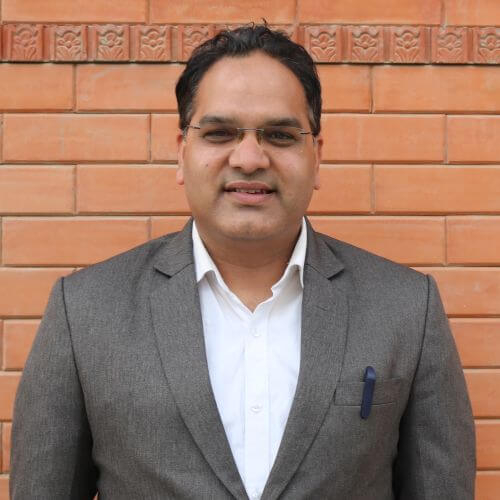
Nepal's First CAR-T Cellular Therapy Programme — Built at KCC
CAR-T (Chimeric Antigen Receptor T-cell) therapy represents the frontier of cancer treatment globally. Dr. Simit Sapkota is establishing Nepal's first CAR-T programme at KCC — a cellular immunotherapy that reprogrammes a patient's own immune cells to attack cancer. He currently provides expert consultation on CAR-T therapy indication and access, so that patients do not need to go abroad for this evaluation.
The Oncologist Who Brings the Future of Cancer Care to Nepal
Dr. Simit Sapkota completed his oncology training at the renowned Postgraduate Institute of Medical Education and Research (PGIMER), Chandigarh—one of India’s leading centers for cancer care and clinical research.
With more than 15 years of clinical experience, he returned to Nepal with a vision to strengthen cancer care through innovation, research, and multidisciplinary treatment approaches—bringing international standards closer to home.
"Every patient deserves to know whether their cancer has a targetable mutation. Not just whether it looks like cancer — but what kind of cancer it is at the molecular level. That distinction changes the treatment entirely."
As Chairperson of Kathmandu Cancer Center, Dr. Sapkota leads the institution's clinical and research direction. He founded KCC's dedicated research department and established Molecular Tumor Board — where a tumour's genetic profile is formally analysed by a multidisciplinary panel to personalise treatment. This is precision oncology as practised at leading hospitals worldwde — now available in Kathmandu.
His clinical specialisation is broad and deliberate: gynaecological cancers (cervical, ovarian, endometrial), gastrointestinal and hepatobiliary cancers (liver, pancreatic, colorectal, stomach, oesophageal), and brain tumours — the cancers that demand the most careful integration of systemic therapy, immunotherapy, and radiation. He coordinates all of these through the Multidisciplinary Tumor Board for every patient.
He is published in The Lancet Oncology — co-authoring the landmark SAARC cancer research analysis, one of the highest-profile studies on oncology in South Asia — alongside researchers from PGIMER, Johns Hopkins, and the University of Pennsylvania.
From Chemotherapy to CAR-T — The Full Spectrum of Modern Cancer Care
Dr. Sapkota manages all systemic cancer therapies. For many patients, the question is no longer just which chemotherapy — but whether a smarter therapy exists. The answer is increasingly yes, and the evaluation for that happens here.
Next-Generation Cancer Therapies
Standard & Combination Therapies
Gynaecological, Gastrointestinal, Brain — And Every Cancer That Needs a Plan
Molecular Tumor Board in Nepal — Your Tumour's Genetics, Your Treatment
Standard cancer treatment uses the same regimens for everyone with the same cancer. Precision oncology asks a harder question: what is different about this specific patient's tumour? The answer — found in the tumour's genetic profile — often changes the treatment entirely.
Step 1 — Tumour Profiling
Next-Generation Sequencing (NGS)
Tumour biopsy tissue is sent for comprehensive genomic profiling — identifying mutations, fusions, amplifications, and biomarkers (TMB, MSI-H, PD-L1) that guide therapy selection.
Step 2 — Expert Panel Review
Molecular Tumor Board Discussion
A multidisciplinary team including oncologists, pathologists, and molecular biologists reviews each genomic report. Dr. Sapkota leads this process — the first of its kind in Nepal.
Step 3 — Matched Treatment
Molecularly Targeted Therapy
Targeted agents are selected based on the tumour's specific mutations — not its tissue of origin alone. A KRAS G12C lung cancer and a KRAS G12C colon cancer now have a targeted option (sotorasib/adagrasib).
Step 4 — Beyond Standard Protocols
Clinical Trial Access & Off-Label Options
For patients where standard options are exhausted, the Molecular Tumor Board identifies clinical trial eligibility and evidence-based off-label options — a pathway that does not exist without this infrastructure.
Published in The Lancet Oncology — Nepal's Oncology Evidence Base, Built at KCC
Dr. Sapkota contributes to the global oncology literature from Nepal, establishing the evidence base that makes locally adapted cancer care possible. He established KCC's dedicated Research Department — the institutional infrastructure that makes clinical research systematic rather than incidental.
The Lancet Oncology · 2024
Cancer Research in SAARC Countries
Co-author of this landmark analysis of cancer research capacity across South Asia — published in The Lancet Oncology, the world's second-highest impact oncology journal. Co-authors include researchers from Johns Hopkins, University of Pennsylvania, and PGIMER.
Read Publication →PLOS ONE · 2024
Nasopharyngeal Carcinoma in Nepal
Senior author on the first large-scale ethnic and geographic characterisation of NPC in Nepal — a study informing how this cancer is staged and treated across the Himalayan region.
Read Publication →Research Leadership
Founder — KCC Research Department
Dr. Sapkota founded and leads KCC's dedicated Research Department — the only cancer centre in Nepal to systematically generate and publish clinical data on Nepali cancer patients, informing locally adapted treatment protocols.
KCC Meaningful Cancer Update
Annual Practice-Changing CME — Programme Coordinator
Leads KCC's annual evidence review bringing oncologists across Nepal up to date on practice-changing research — translating global trials into Nepal's specific clinical context.
Dr. Simit Sapkota — In His Own Words
Dr. Sapkota on new advances in cancer treatment, and patient care at Kathmandu Cancer Center
Dr. Sapkota Sapkota on new immunotherapy treatment available at Kathmandu Cancer Center
Should I Go to India or abroad for My Cancer?
The honest answer: most of what those institutions offer is also available here. The difference is cost, proximity, and continuity — not capability. Dr. Sapkota trained at PGIMER- the same institution that trains many of the oncologists patients see in India's top hospitals.
Going to India
- 3–4x higher total cost including travel
- Weeks of waiting for appointments at top centres
- Treatment without family support nearby
- Molecular profiling often not explained in simple language
- Follow-up requires repeated trips
- No continuity with Nepal-based doctors
Treatment at KCC Nepal
- PGIMER-trained specialist — best institute in India
- Molecular Tumor Board — Nepal's pioneer
- CAR-T consultation and access — Nepal's only
- Family beside you throughout treatment
- Same team from diagnosis to long-term follow-up
उन्नत क्यान्सर उपचार — अब नेपालमै, भारत जानुपर्दैन
डा. सिमित सापकोटा काठमाडौँ क्यान्सर सेन्टर (KCC) का अध्यक्ष तथा नेपालका अग्रणी क्यान्सर विशेषज्ञ हुन्। उहाँले भारतको सर्वोत्कृष्ट मेडिकल संस्थाहरूमध्ये एक — PGIMER, चण्डीगढ़ — बाट MD Clinical Oncology पूरा गर्नुभयो र १५ वर्षभन्दा बढीको अनुभव संग क्यान्सर उपचारमा समर्पित हुनुहुन्छ।
उहाँले नेपालमा प Molecular Tumor Board स्थापना गर्नुभयो — जहाँ बिरामीको क्यान्सरको genetic profile (आनुवंशिक बनावट) विश्लेषण गरेर सबैभन्दा सटीक उपचार तय गरिन्छ। यो प्रविधि अमेरिका र युरोपका शीर्ष क्यान्सर केन्द्रहरूमा मात्र उपलब्ध थियो — अहिले नेपालमा पनि।
थप रूपमा, उहाँले नेपालमा पहिलोपटक CAR-T Cellular Therapy कार्यक्रम निर्माण गर्दै हुनुहुन्छ — यो एउटा अत्याधुनिक उपचार हो जसमा बिरामीको आफ्नै immune cells लाई क्यान्सरसँग लड्न प्रशिक्षण दिइन्छ। यस उपचारको परामर्श अहिले KCC मा नै उपलब्ध छ।
डा. सापकोटा महिलाहरूको क्यान्सर (पाठेघर, डिम्बाशय, गर्भाशयको क्यान्सर), पाचन प्रणालीको क्यान्सर (कलेजो, प्यान्क्रियाज, ठूलो आन्द्रा), र मस्तिष्कको ट्युमरका विशेषज्ञ हुन्। Immunotherapy, Targeted Therapy, र Chemotherapy सबै उपचार KCC मा उपलब्ध छन्।
उहाँ KCC City Clinic, न्यू बानेश्वर र KCC, तथाली, भक्तपुर दुवै ठाउँमा बिरामी हेर्नुहुन्छ। WhatsApp मार्फत पनि अपोइन्टमेन्ट लिन सकिन्छ — City Clinic: ९७६३-४९०९५० · KCC Tathali: ९८१८-२२६२३७
What Patients Ask Before Coming to See Dr. Sapkota
📞 Call: 01-5312123
💬 WhatsApp: 9763-490950
KCC Main Hospital, Tathali, Bhaktapur:
📞 Call: 01-5091629
💬 WhatsApp: 9818-226237
WhatsApp messages are welcome for appointment queries and sending reports. No referral letter is required. Bring all available scans, biopsy reports, and prior treatment records to your first consultation.
Reach Dr. Simit Sapkota — Call or WhatsApp
Send your reports directly via WhatsApp and get a consultation appointment confirmed. No referral letter required. Bring all scans, biopsy reports, and prior treatment records.