New KCC City Clinic —  New Baneshwor →
Clinical Oncology · Chemotherapy · Immunotherapy · Radiotherapy

Dr. Subhas Pandit

MBBS (BPKIHS) · MD Radiation Oncology (AIIMS, New Delhi) · Fellowship in Head & Neck IMRT (UCL Belgium)
Associate Professor & Academic Director, Kathmandu Cancer Center

AIIMS-trained. Nepal's complete cancer specialist — for chemotherapy, immunotherapy, targeted therapy, and precision radiotherapy.
16+ Years of
Oncology Practice
238+ Google Scholar
Citations
3 Continents as
Invited Speaker
5 International Book
Chapters
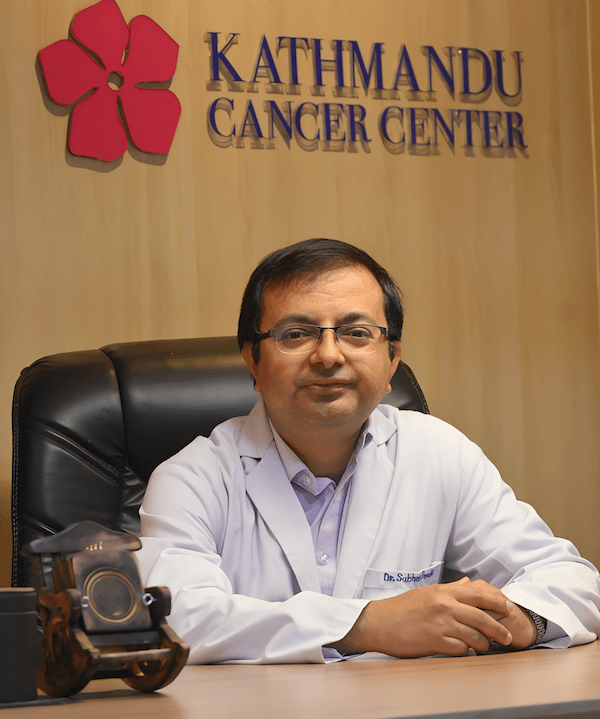
Dr. Subhas Pandit, best cancer doctor in Nepal, Clinical Oncologist at Kathmandu Cancer Center

Trained at

AIIMS, New Delhi · India's #1 Medical Institution
MD Radiation Oncology · Fellowship UCL Belgium

OPD Availability
KCC City Clinic — Every Day New Baneshwor, Kathmandu · Daily OPD · 01-5312123 · 9763-490950
KCC Tathali — Main Hospital Bhaktapur · Radiation Planning, Treatment & Inpatient · -01-5091629

AIIMS New Delhi · 238+ Citations · International Speaker: Canada, Australia, Africa

First IMRT in Nepal First Total skin/ Total Body radiotherapy in Nepal Expert in Head/neck brachytherapy Immunotherapy

Nepal's Pioneer of IMRT and VMAT Radiotherapy

Dr. Subhas Pandit was thefirst oncologist to introduce IMRT (Intensity-Modulated Radiation Therapy) and VMAT in Nepal — precision radiotherapy techniques that deliver higher tumour doses while protecting surrounding healthy tissue. He published the first IMRT outcomes data from Nepal in Annals of Oncology — the world's highest-impact oncology journal.

About Dr. Subhas Pandit

Cancer Specialist

Dr. Subhas Pandit trained in radiation oncology atAll India Institute of Medical Sciences (AIIMS), New Delhi— India's highest-ranked medical institution, the same institution where India's most senior oncologists trained. He then completed a fellowship in Head and Neck IMRT under Prof. Vincent Gregoire at UCL Belgium — one of the most cited radiation oncologists in the world and architect of international head and neck radiotherapy guidelines.

"A clinical oncologist does not choose between chemotherapy and radiation. He designs the complete treatment — integrating both, coordinated from day one, through the same physician, for the same patient."

As a Clinical Oncologist, his scope covers the full spectrum: chemotherapy, immunotherapy, targeted therapy, concurrent chemoradiation, precision radiotherapy, and brachytherapy. In cancers that require both chemotherapy and radiation — head and neck, cervical, lung, rectal, oesophageal — having one specialist coordinate both produces better-timed, better-integrated, and safer treatment.

He returned to Nepal and built a comprehensive oncology programme at Kathmandu Cancer Center from the ground up — introducing IMRT, VMAT, and image-guided brachytherapy to the country for the first time. He serves as Academic Director at KCC and has led research focused program, setting the national standard .

Complete Treatment Capabilities

Chemotherapy, Immunotherapy, Targeted Therapy, and Radiotherapy — All at KCC

Dr. Pandit manages the full range of cancer treatments. Patients with any cancer requiring systemic therapy, radiation, or both do not need to travel to India or abroad . The same international protocols are applied here.

Systemic Cancer Therapies

Chemotherapy Platinum, taxane, anthracycline, alkylating protocols for all cancer types
Immunotherapy Checkpoint inhibitors: pembrolizumab, nivolumab, atezolizumab, durvalumab
Targeted Therapy EGFR, HER2, VEGF, ALK, ROS1 inhibitors — molecularly selected
Concurrent Chemoradiation Simultaneous chemo + radiation — the gold standard for H&N, cervical, lung, rectal
Induction Chemotherapy TPF, FLOT, FOLFOX, CAPOX — tumour reduction before radical treatment
Adjuvant & Maintenance Therapy Post-surgery systemic treatment to prevent recurrence

Precision Radiation Therapy

IMRT — Intensity-Modulated Radiation Therapy First introduced in Nepal by Dr. Pandit · Head & neck, prostate, brain
VMAT — Volumetric Arc Therapy First introduced in Nepal by Dr. Pandit · Faster delivery, reduced exposure
IGBT — Image-Guided Brachytherapy Cervical cancer, rectal cancer — gold standard internal radiation
Interstitial Brachytherapy Head & neck, breast, lip ,lung ,liver — precision implant-based radiation
SRT / SBRT — Stereotactic Body Radiation Therapy
TBI — Total Body Irradiation Pre-bone marrow transplant conditioning
TSET — Total Skin Electron Therapy Mycosis fungoides / cutaneous lymphoma
Palliative Radiotherapy Bone pain, brain metastases, airway obstruction — rapid symptom control
Cancer Types Treated

Every Cancer — Managed by One Specialist Who Knows the Full Picture

Head & Neck CancerOral cavity, throat, larynx, hypopharynx — Dr. Pandit's specialty
Nasopharyngeal CancerPublished research on NPC in Nepal — chemoradiation with IMRT
Lung CancerIMRT, immunotherapy (durvalumab), targeted therapy (EGFR/ALK)
Breast CancerPost-mastectomy radiation, breast conserving RT, chemotherapy
Cervical CancerChemoradiation + IGBT brachytherapy — definitive curative treatment
Rectal CancerNeoadjuvant chemoradiation, TNT protocol, IGBT for residual disease
Prostate CancerIMRT/VMAT, brachytherapy, ADT — international protocols
Oesophageal CancerDefinitive chemoradiation, neoadjuvant CROSS protocol
Brain TumoursGBM, metastases — temozolomide chemoradiation, SRS
LymphomaCHOP/R-CHOP, consolidation radiation, TBI pre-transplant
Stomach CancerPerioperative FLOT, post-operative chemoradiation
Skin & Cutaneous TumoursBasal cell, SCC, mycosis fungoides — TSET and targeted radiation
Clinical Approach

International Protocols. Multidisciplinary Planning. Applied in Nepal.

Every patient at KCC is discussed at the Multidisciplinary Tumour Board. Chemotherapy, radiation, surgery — no single modality is planned in isolation. This is how the world's best cancer centres work. It is how KCC works under Dr. Pandit's leadership.

Head & Neck Cancer

Concurrent Cisplatin-IMRT

Interstitial and surface brachytherapy

Cervical Cancer

Chemoradiation + IGBT Brachytherapy

GEC-ESTRO image-guided adaptive brachytherapy protocol — the global gold standard for definitive cervical cancer treatment.

Lung Cancer

Chemotherapy. Radiotherapy. Immunotherapy

Available at KCC.

Prostate Cancer

Radiotherapy. Hormones. Chemotherapy

Complete range of treatment for prostate cancer.

Research & Publications

With 238+ Google Scholar citations and publications in journals including Annals of Oncology, PLOS ONE, and Journal of Contemporary Brachytherapy, Dr. Pandit is one of Nepal's most cited oncologists .

Annals of Oncology · 2019

First IMRT Paper from Nepal

A landmark for oncology in the country.

Read Publication →

PLOS ONE · 2024

Nasopharyngeal Carcinoma in Nepal: Ethnic & Geographic Distribution

First large-scale characterisation of NPC patterns in Nepal by ethnicity, geography, and histology . Cited by international NPC researchers.

Read Publication →

Radiation Oncology Journal

Lip Brachytherapy

First case series on lip cancer treatment without surgey and excellent cosmetic outcome

Read Publication →

Book Chapters

Radiation Oncology & Neuro-Oncology

Authored chapters in two medical reference books — Radiation Oncology and Neuro-Oncology — serving as academic references for the regional oncology community.

Google Scholar →

Invited Speaker — Canada, Australia, Africa

Dr. Pandit has been invited to present at international brachytherapy and oncology conferences across three continents — sharing Nepal's clinical experience and outcomes with the global oncology community.

Watch

Dr. Subhas Pandit — In His Own Words

Dr. Subhas Pandit on cancer treatment, clinical oncology, and patient care at Kathmandu Cancer Center

The Question Every Patient Asks

Should I Go to India for Cancer Treatment?

In most cases, no. The standard patients seek in India is determined by where their doctors trained. Dr. Subhas Pandit trained at AIIMS — the institution that sets that standard. The protocols he uses at KCC are the same ones he learned there, and in some cases refined further at UCL Belgium.

Going to India

  • High travel and hotel costs throughout treatment
  • Language barriers in clinical communication
  • Away from family for weeks or months
  • Difficult follow-up requiring repeat travel
  • Risk of care fragmentation across visits

Treatment at KCC Nepal

  • AIIMS-trained oncologist — same source as India
  • Same IMRT, chemo, immunotherapy protocols
  • Family nearby throughout treatment
  • Same team from diagnosis to follow-up
  • MDT Tumour Board for every new case
  • Significantly lower total treatment cost
नेपालीमा जानकारी

क्यान्सर उपचार — नेपालमै सम्भव छ, भारत जानु पर्दैन

डा. सुभाष पण्डित नेपालका सर्वश्रेष्ठ क्यान्सर विशेषज्ञहरूमध्ये एक हुन्। उहाँले भारतको सबभन्दा प्रतिष्ठित मेडिकल संस्था — AIIMS (All India Institute of Medical Sciences), नयाँ दिल्ली — बाट Radiation Oncology मा MD गर्नुभयो। त्यसपछि बेल्जियमको UCL विश्वविद्यालयमा Head & Neck Cancer को Radiation Therapy मा थप प्रशिक्षण पनि लिनुभयो।

उहाँले नेपालमा पहिलोपटक IMRT (एक उन्नत किसिमको Radiation Therapy) र VMAT सुरु गर्नुभयो — र यी प्रविधिहरूबारे विश्वकै सर्वोच्च अन्कोलोजी जर्नल Annals of Oncology मा अनुसन्धान प्रकाशित गर्नुभयो। यो उपलब्धि नेपालका अन्य कुनै पनि अन्कोलोजिस्टले भेट्टाएका छैनन्।

डा. पण्डित केवल Radiation मा सीमित छैनन् — उहाँ Clinical Oncologist हुन्, जसले Chemotherapy, Immunotherapy र Targeted Therapy पनि हेर्नुहुन्छ। अर्थात् क्यान्सरको सम्पूर्ण उपचार एउटै विशेषज्ञबाट प्राप्त गर्न सकिन्छ। क्यान्सरको जटिल उपचारमा यो एकीकृत दृष्टिकोण निकै महत्त्वपूर्ण छ।

उहाँ KCC City Clinic, न्यू बानेश्वर, काठमाडौँ मा हरेक दिन बिरामी हेर्नुहुन्छ। ठूलो आन्द्राको, घाँटीको, फोक्सोको, स्तनको, पाठेघरको क्यान्सर लगायत सबै किसिमका क्यान्सरको उपचार अहिले काठमाडौँ क्यान्सर सेन्टर (KCC) मा नै हुन्छ। अपोइन्टमेन्टका लागि: ०१-५३१२१२३ वा ९७६३-४९०९५०

Frequently Asked Questions

What Patients Ask Before Their First Consultation

Dr. Subhas Pandit is one of Nepal's most credentialled and internationally trained clinical oncologists. He trained at AIIMS New Delhi — India's premier medical institution — and has published cancer research in Annals of Oncology, the world's leading oncology journal. He pioneered IMRT and VMAT in Nepal and provides chemotherapy, immunotherapy, targeted therapy, and precision radiation therapy at Kathmandu Cancer Center. He sees patients every day at KCC City Clinic, New Baneshwor.
Yes. Chemotherapy is available at KCC and its City Clinic in New Baneshwor, Kathmandu. Dr. Subhas Pandit plans and oversees chemotherapy for all cancer types — breast, lung, head and neck, cervical, colorectal, lymphoma, and others — using internationally validated protocols coordinated through the Multidisciplinary Tumour Board.
Yes. Immunotherapy including checkpoint inhibitors (pembrolizumab, nivolumab) is available at KCC. Dr. Pandit manages immunotherapy protocols for lung cancer , head and neck cancer, cervical cancer, and other malignancies where immunotherapy is indicated. Appropriate patient selection and toxicity management are integral to his practice.
A medical oncologist manages systemic therapies — chemotherapy, targeted therapy, immunotherapy. A clinical oncologist manages all of those plus radiation therapy. For cancers that need both (head and neck, cervical, lung, rectal, oesophageal), a clinical oncologist designs and coordinates the complete treatment from one desk, preventing the gaps and delays that arise when two separate specialists must align. Dr. Subhas Pandit's clinical oncology training gives him this broader scope.
Yes. Dr. Subhas Pandit was the first oncologist to introduce IMRT (Intensity-Modulated Radiation Therapy) in Nepal. He published the first IMRT outcomes paper from Nepal in Annals of Oncology. IMRT, VMAT, SBRT, and image-guided brachytherapy are all available at Kathmandu Cancer Center. Patients with head and neck, lung, prostate, or cervical cancer in particular benefit significantly from IMRT's precision.
Yes. KCC has one of the most advanced brachytherapy programmes in Nepal under Dr. Pandit's leadership. Image-guided brachytherapy (IGBT) for cervical and rectal cancer, interstitial brachytherapy for head and neck and breast cancer, and lip brachytherapy are all performed at KCC. Dr. Pandit has presented brachytherapy outcomes internationally and published case reports in peer-reviewed journals.
Targeted therapy is available for multiple cancer types at KCC: EGFR inhibitors for lung cancer (erlotinib, gefitinib, osimertinib), HER2-targeted therapy for breast cancer (trastuzumab, pertuzumab), VEGF inhibitors, and other molecularly targeted agents. Where appropriate, molecular tumour profiling guides selection of the most effective agent for each patient's specific cancer biology.
KCC City Clinic, New Baneshwor, Kathmandu — every day (01-5312123 · 9763-490950). KCC Tathali, Bhaktapur — for radiation planning, treatment, and admitted patients (+977-1-4790152). Call ahead to confirm appointment availability. No referral letter is required for a first consultation — bring all available scans, reports, and biopsy results.
In most cases, staying in Nepal is the right decision. Dr. Pandit trained at AIIMS — the institution that sets the standard for cancer care in India. The chemotherapy protocols, radiation techniques, and immunotherapy regimens he uses at KCC are the same ones applied at AIIMS, Tata Memorial, and leading Indian cancer centres. Staying in Nepal means lower cost, no language barrier, continuous care from the same team, and your family beside you throughout treatment.

Refer a Patient to Dr. Subhas Pandit

GPs, surgeons, and specialists across Nepal can refer patients directly. Oncology referrals are reviewed at the Multidisciplinary Tumour Board. A written management plan is provided back to the referring clinician. Urgent cases are accommodated within 24 hours.