 Kathmandu
Cancer Center
Kathmandu
Cancer Center
Kathmandu
Cancer Center
Kathmandu
Cancer Center
KCC Cancer Patient Guide — Updated 2026
Plain-language answers for patients, families, and survivors. Whether you've just received a diagnosis or are years into recovery — this guide walks you through what to expect at every stage of care at KCC.
नेपालीमा
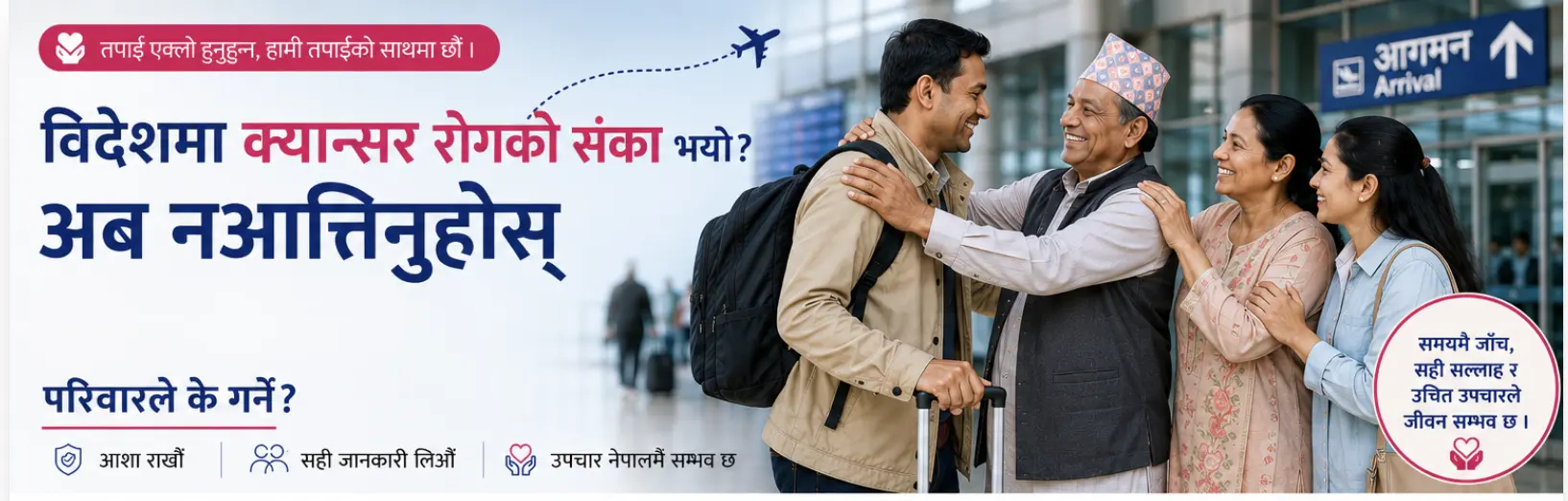
क्यान्सर थाहा भएपछि के गर्ने? उपचारमा के हुन्छ? खाना कसरी खाने? यो गाइडमा सबै प्रश्नको सरल जवाफ छ — नेपाली भाषामा।
पूरा गाइड नेपालीमा पढ्नुस्Find Your Section
I've just been told I have cancer
What documents to bring, what happens at the first appointment, how to prepare, and what questions to ask.
भर्खरै क्यान्सर थाहा भयो — के गर्ने?
First steps →
I'm receiving chemotherapy or radiotherapy
What each treatment involves day to day, managing side effects, diet, attendance, and when to call for help.
उपचारमा छु — के अपेक्षा गर्ने?
Treatment guide →
My treatment is finished — what now?
Follow-up schedule, surveillance scans, managing long-term effects, and staying well after cancer.
उपचार सकियो — अब के गर्ने?
Survivor's guide →
Early Detection
Most cancers are far more treatable when caught early. These are the warning signs Nepali patients most commonly overlook or delay acting on — often by months.
English — Warning signs to act on immediately
A lump that is new, growing, or painless · Unexplained weight loss of more than 5 kg · Blood in urine, stool, or cough · A sore or ulcer that does not heal in 3 weeks · Difficulty swallowing · A mole or skin patch that is changing · Post-menopausal bleeding · Persistent hoarseness or change in voice · Unexplained fatigue lasting weeks
नेपाली — तुरुन्त ध्यान दिनुपर्ने लक्षणहरू
नयाँ गाँठो वा सुन्निने · अकारण तौल घट्नु (५ केजी भन्दा बढी) · पिसाब, दिसा वा खोकीमा रगत आउनु · ३ हप्तासम्म नसक्ने घाउ · निल्न गाह्रो हुनु · तिल वा छालामा परिवर्तन · रजस्वला बन्द भएपछि रगत आउनु · आवाज परिवर्तन · कारण नभएको लामो थकान
Just Diagnosed
A diagnosis is overwhelming. Here is the clearest path from receiving a diagnosis to sitting in front of the right specialist with a plan.
WhatsApp your biopsy report or diagnosis to 9818-226237 or call 01-5091629. Waiting while gathering documents is the most common — and most harmful — delay. KCC can begin with whatever you have.
ढिला नगर्नुस् — आजै WhatsApp गर्नुस् वा फोन गर्नुस्।
Bring what you have. The most important items are listed below. A clear photo on your phone is accepted for initial review.
An expert oncologist reviews your reports, takes your history, examines you if needed, and explains your diagnosis in Nepali. Your case is then placed on the multidisciplinary tumour board agenda — usually within 1 to 3 days.
पहिलो भेटमा वरिष्ठ अन्कोलोजिस्टले तपाईंको रिपोर्ट हेर्छन् र नेपालीमा बुझाउँछन्।
Your case is discussed by the full multidisciplinary team. You receive a written treatment plan with timeline, cost estimate, and start date — before treatment begins. No surprises.
No referral letter required. Walk-ins welcome. If coming from outside Kathmandu, photos of documents via WhatsApp are accepted for initial review.
During Treatment
Most cancer treatment at KCC uses one or more of these modalities. Click any treatment for the full patient guide on what to expect, session by session.
Call KCC or go to emergency immediately if you have:
KCC Emergency: 01-5091629 · Ambulance: 102
English — Fever rule
Fever above 38°C after chemotherapy = go to hospital immediately. Do not take paracetamol and wait. Do not wait until morning. Neutropenic fever can become life-threatening within hours.
नेपाली — ज्वरो नियम
कीमोथेरापी पछि ज्वरो ३८°C भन्दा बढी भएमा तुरुन्त अस्पताल जानुस्। Paracetamol खाएर सुत्नु हुँदैन। बिहान पर्खनु हुँदैन। यो मेडिकल इमर्जेन्सी हो।
Cancer & Nutrition — KCC Patient Guide
Good nutrition during cancer treatment is not a luxury — it directly affects your ability to tolerate treatment, recover between cycles, maintain immunity, and heal after surgery. Many patients lose weight during treatment; even a 5–10% drop in body weight can affect treatment decisions. KCC's oncology team will guide you on nutrition specific to your treatment — this pillar gives you the foundation.
Nausea reduces appetite before it arrives. Small, frequent meals (5–6 per day) are better tolerated than 3 large ones during chemotherapy cycles.
Protein supports tissue repair and immune function. Dal, lentils, eggs, yoghurt, paneer, and chicken are well-tolerated sources. Aim for protein at every meal.
During low blood count periods (days 7–14 after chemotherapy), avoid raw meat, raw fish, unpasteurised dairy, and unwashed raw vegetables. Well-cooked dal bhat is safe.
Grapefruit and its juice affect the metabolism of several chemotherapy and targeted therapy drugs — not general health advice but a genuine drug interaction. Avoid throughout treatment.
Detailed pages are being developed. Existing pages are linked; pages marked "Coming Soon" will be added shortly.
English — Key message
If you are losing weight, have difficulty eating, or have not eaten properly for more than 3 days — tell your oncologist at your next visit. This is clinical information, not a complaint. Nutritional status directly affects chemotherapy dosing and your body's ability to tolerate treatment.
नेपाली — मुख्य सन्देश
तौल घटिरहेछ, खान गाह्रो छ, वा ३ दिनभन्दा बढी राम्रोसँग खान सकिएको छैन भने — अर्को अपोइन्टमेन्टमा डाक्टरलाई भन्नुस्। यो गुनासो होइन — यो महत्त्वपूर्ण clinical जानकारी हो।
Prevention & Early Detection
Screening finds cancer before symptoms appear — when it is most treatable. KCC offers Nepal's most comprehensive cancer screening programme at both Tathali and the City Clinic.
English — Screening message
Screening is for people with no symptoms. If you already have a symptom — a lump, bleeding, pain — that is not screening; that is a diagnostic appointment. WhatsApp or call KCC immediately.
नेपाली — स्क्रिनिङ्ग बारे
स्क्रिनिङ्ग लक्षण नभएका मानिसहरूका लागि हो। यदि गाँठो, रगत, वा दुखाइ जस्ता लक्षण छ भने — यो स्क्रिनिङ्ग होइन; तुरुन्त KCC मा आउनुस् वा WhatsApp गर्नुस्।
Costs, Insurance & Financial Support
A written cost estimate is provided after tumour board review and before treatment begins — no unexpected bills. For a rough indicative estimate before your first appointment, WhatsApp your diagnosis, stage, and proposed treatment plan to 9818-226237. The administrative team will respond within 24 hours.
Use the interactive cost estimator →
KCC treatment typically costs 60–80% less than equivalent private hospital care in India — before accounting for flights (NPR 15,000–40,000 return), accommodation for 1–2 family members for 2–6 months, and daily expenses. NHIF coverage is only valid in Nepal. Total savings for a typical breast or head-and-neck cancer course: NPR 4–10 lakh or more.
Full Nepal vs India comparison →
KCC has a patient welfare fund and works with charitable organisations providing financial support for cancer patients. If affordability is a concern, raise this at your first appointment — there are more options than most patients are aware of. The KCC social worker team assists with government scheme applications.
Cash (NPR) · eSewa, Khalti, and digital wallets · Bank transfer · NHIF direct billing (empanelled) · Private insurance pre-authorisation · International bank transfer for overseas patients. Itemised receipts provided for all payments.
Continuing Treatment from India
You can continue your treatment at KCC without restarting cycles. KCC follows the same NCCN and ESMO protocols as India's premier oncology centres. All drugs used at RGCI, Tata Memorial, Apollo, and Medanta are available at KCC.
Transfer process — 3 steps
WhatsApp your treatment summary, drug protocol, and recent blood work to 9818-226237.
KCC confirms drug availability and cost within 24–48 hours — before you travel.
Your next cycle is scheduled at KCC within 3–5 working days of sending documents. Cycles continue from where they left off.
After Treatment
Completing treatment is not the end of your care — it is the beginning of the surveillance phase. Surveillance detects recurrence early, when it is most treatable.
Clinic review every 3 months. Cancer-type specific blood tests and scans. This is the highest-recurrence-risk period — attendance is clinically essential, not optional.
Clinic review every 6 months. Annual imaging for most cancer types. Risk continues to fall but remains real — follow-up continues.
Annual clinic review for most cancers. Some types require ongoing monitoring indefinitely (e.g. breast cancer: annual mammogram; colorectal: colonoscopy schedule). Long-term follow-up at KCC is one of the key advantages of treating in Nepal — every surveillance visit is in Kathmandu, not Delhi.
If you notice new symptoms between appointments — a new lump, unexplained pain, unexpected weight loss, or anything that feels wrong — contact KCC immediately. Do not wait for the next scheduled visit. 01-5091629
Complete Guide Library
Each guide below answers 20–30 questions specific to that treatment or topic — written for Nepali patients at KCC.
Frequently Asked Questions
Bring whatever you have — do not delay coming because documents are incomplete. In order of priority: biopsy/pathology report, scan reports with CD/USB images, list of all medications (including herbal and Ayurvedic), NHIF or insurance card, and a trusted family member. Photos of documents on your phone are accepted for initial review.
Urgent cases (rapidly growing tumours, obstruction, bleeding) are typically seen within 2 to 3 working days. Standard first appointments are usually within one week. The fastest path: WhatsApp your biopsy report to 9818-226237 before calling. This allows the team to triage your case and prepare — which often means a shorter, more productive first consultation.
Do not wait. Earlier staging = better outcomes. The correct response to a cancer diagnosis is immediate action, not weeks of gathering documents.
No referral is required. You can self-refer to KCC directly. Call 01-5091629, WhatsApp 9818-226237, or walk in. A referral letter is helpful but not a requirement and will not delay your appointment.
Most patients can eat a normal Nepali diet with modifications. Avoid grapefruit entirely throughout treatment — it genuinely interacts with several chemotherapy drugs. On infusion day, eat a light meal before attending; avoid heavy, fatty, or strongly spiced food. Dal, rice, and yoghurt are well tolerated by most patients.
During low blood count days (typically days 7–14 after infusion): avoid raw meat, raw fish, unpasteurised dairy, and unwashed raw vegetables. Well-cooked food is safe. See the Cancer Nutrition section for full guidance.
Tell your oncologist everything you are taking. Several herbal and Ayurvedic preparations — including widely used ones in Nepal — interact directly with chemotherapy and targeted therapy drugs. Some reduce drug effectiveness. Some increase toxicity. Some affect liver function in ways that change dosing.
KCC oncologists will not dismiss or judge your use of complementary approaches. They will review what you are taking and advise on what can safely continue. The harm comes from secrecy — not from asking.
Call KCC on 01-5091629 or WhatsApp 9818-226237 before missing a session. Do not simply not attend. Chemotherapy cycles can be safely delayed 1–2 weeks if blood counts are low or if you are unwell — delayed cycles do not generally harm outcomes. Radiotherapy missed sessions are more significant and must be managed by your radiation oncologist.
Emergency: Fever above 38°C after chemotherapy — go to hospital immediately. This is not a missed appointment; it is a medical emergency.
Children are aware something is wrong before they are told. Secrecy creates anxiety; age-appropriate honesty reduces it. Use the word "cancer" — euphemisms create confusion and distrust later. Explain in concrete terms: "Baba has cancer. Doctors are giving him medicine to kill the cancer. Some days he will feel tired — that is normal and does not mean he is getting worse."
Reassure about what will not change: school, routines, who will be home. Give children something to do — helplessness is the hardest emotion. KCC's psychosocial team can provide guidance for specific ages and situations.
After treatment ends, surveillance continues. Typical schedule: every 3 months for the first 2 years, every 6 months for years 3–5, annually from year 5 onwards. Specific scans and blood tests depend on your cancer type.
All post-treatment follow-up is in Kathmandu — this is one of the major advantages of treating in Nepal rather than India, where follow-up appointments would require repeated flights. If you notice new symptoms between appointments, contact KCC immediately rather than waiting for the next scheduled visit.
Yes, completely. All patient information at KCC is confidential under Nepal's Individual Privacy Act 2018. Your diagnosis will not be shared with your employer, family members you have not consented to inform, or insurers beyond what is required for your specific claim. If you have specific confidentiality concerns — for example, you do not want certain family members to know — raise this at your first visit and a clear instruction will be placed in your file.
Every oncologist at KCC has one policy: no question is too basic, no concern is too small. WhatsApp or call — a clinical answer comes back, not a voicemail.
 Book Appointment